


In Portrait | Stiftung Charité – providing impetus, promoting life sciences in Berlin, shaping the future
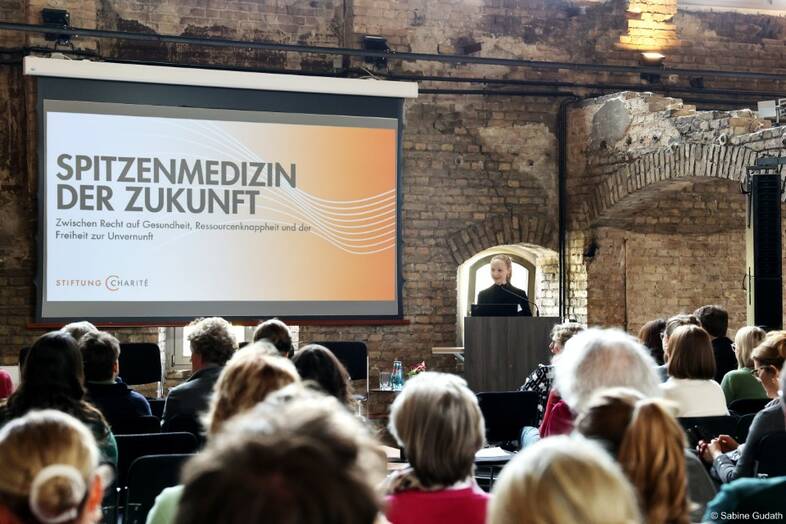
For twenty years, Stiftung Charité has been promoting life sciences and university medicine in Berlin. The independent, private-law, non-profit foundation was established by entrepreneur Johanna Quandt (1926–2015) with the aim of developing and establishing Berlin as one of the leading global locations in the field of life sciences. Funding is provided to institutions affiliated with Charité – Universitätsmedizin Berlin and other life science partner institutions. The wide range of funding programs offers support opportunities at every stage of an academic career, for students as well as for professors with chairs.
The foundation has close ties to Berlin's Charité hospital and the capital, and not just because of its name. “We see Berlin's potential to establish itself as a leading international location for life sciences, both in basic biomedical and clinically oriented research, as well as in their application,” explains Marie Hoffmann, General Manager at the foundation’s Berlin head office. Strengthening Berlin's science and innovation system is a key concern of Stiftung Charité.
Born in Berlin herself, founder Johanna Quandt had a personal connection with life sciences as well. She was a trained medical-technical assistant and granddaughter of Max Rubner, who in 1891 succeeded Robert Koch as chair of hygiene in Berlin and made important contributions to research in the field of nutritional science until his death in 1932. Johanna Quandt was closely involved in the work of the Stiftung Charité until her own death. Her son Stefan Quandt is her successor on the foundation's committees.
Entrepreneurship at Charité
In its early years, Stiftung Charité focused primarily on promoting entrepreneurial thinking and technology transfer within Charité – Universitätsmedizin Berlin. One example of this was the Entrepreneurship Summit, held annually from 2008 until 2022 to promote exchange between science, entrepreneurship and venture capital in the field of life sciences in Berlin. Another important early area of focus was support programs in the field of technology transfer, such as the Max Rubner Award. Launched in 2009 and endowed with EUR 100,000, this prize is still awarded today for ideas with entrepreneurial approaches to structural change, with the aim of enabling innovation. In this context, mention should also be made of the Private Excellence Initiative Johanna Quandt, which provided funding to support scientists at all stages of their academic development. A total of 569 scientists received support during the initiative's term from 2013 to 2022. Through various programs promoting science, the Excellence Initiative was also closely linked to the establishment and further development of the Berlin Institute of Health (BIH) and its translational cooperation with Charité – Universitätsmedizin Berlin as well as the Max Delbrück Center for Molecular Medicine (MDC).
Focus areas of funding
Stiftung Charité currently promotes life sciences within Charité – Universitätsmedizin Berlin and life science partner institutions in the in the fields of Innovation Funding, Research Funding and Open Life Science.
Innovation Funding in particular is closely linked to the founding mission of Stiftung Charité. The funding programs in this area are designed to stimulate innovative approaches at Charité and in its environment, and intended to support specific technology transfer projects. The field of innovation promotion includes, for example, Project and Event Funding as well as the Inventors for Health program.
Under the banner of Research Funding, the Excellence Initiative Johanna Quandt program is continued and further developed. Among other initiatives, the Research Funding segment manages the financing of Deutschlandstipendien, the Clinician Scientists program, networking events and the Visting Fellows program. The latter aims to attract high-ranking scientists to Berlin on a temporary or permanent basis.
Open Life Science was established as a new focus in the promotion work of Stiftung Charité in 2022. Because the private non-profit foundation has an entrepreneurial attitude, it always prioritizes the needs of its target group while also taking into account the broader social context. “We therefore develop customized funding programs that are often unique and – owing to their willingness to take risks – provide new impetus. We build on our strengths developed over the past 20 years in the area of personal and structural support, and we are constantly trying out new things by setting new priorities,” Marie Hoffmann comments on the further development and new establishment of funding programs.
The focus of Open Life Science is to increase the trustworthiness of life sciences. This is to be achieved through improved science communication in the Berlin life sciences, for example via such funding programs as science x media Tandem and Wisskomm@Charité.
In addition, Stiftung Charité supports the SPARK Berlin program for the promotion of innovations in health research. The foundation established this program together with the Berlin Institute of Health (BIH) in 2015, emulating Stanford University’s SPARK initiative.
These versatile funding programs and support measures have enabled numerous success stories and innovations over the past 20 years. Through the SPARK Berlin program, for example, Felix Lorenz, one of the founders of Captain T Cell, received funding to support the establishment of his own company. Berlin Partner/HealthCapital also accompanied Captain T Cell from the beginning and supported Lorenz and his team in the areas of promotion, financing and networking as well as in finding cooperation partners and locations. Felix Lorenz comments on the importance of support in the early stages, “SPARK Berlin was the first funding we ever received. It was decisive in giving us the encouragement we needed to turn a scientific idea into our own project. It sent an important signal, namely that our approach really had the potential to become a start-up. This early support had a significant impact on our journey.”
Another example is the Patient Monitoring Roundtable (PMRT) series of events of the Institute of Medical Informatics at Charité and the Initiative for Innovation and Collaboration in Healthcare (INCH) led by Akira-Sebastian Poncette, professor for Clinical Implementation Science in Digital Health and Deputy Director of the institute. Stiftung Charité supported the PMRT in 2024 in the context of its Project and Event Funding initiative. The platform has been promoting interdisciplinary collaboration between healthcare, industry and science in the field of new monitoring and data-based technologies since 2021. In November, the 32nd edition of the roundtable, which has become an established forum for exchange at Charité, was held. Cluster HealthCapital supports the roundtable through visibility in regional industry and science. “Owing to the promotion of Stiftung Charité, we were able to further develop the PMRT and considerably deepen the interdisciplinary exchange on monitoring and digital medicine. The support brings healthcare, research and industry together in one place and creates a space for joint learning processes. The accompanying communication of Cluster HealthCapital Berlin-Brandenburg, for example through newsletter content or active participation in the roundtables, creates additional visibility and reach,” explains Poncette.
Innovative future
With regard to the future, the foundation will continue to focus on innovation – including within its own organization. “The foundation will continue to be active in its three established focus areas Innovation Funding, Research Funding and Open Life Science,” says Marie Hoffmann. “We are intensively examining the challenges that the healthcare system will face in the coming years and decades from a variety of perspectives and will attempt to provide the best possible added value with appropriate funding programs, including new ones.” Hoffmann is certain that with this background, the coming two years will be particularly interesting.
Further information:
- Stiftung Charité
- Funding programs of Stiftung Charité
- SPARK Berlin
- Captain T Cell
- Interview with Akira-Sebastian Poncette
- Initiative for Innovation and Collaboration in Healthcare (INCH)

