


Interview | Aurélien Claeyssen, Managing Director, JPT Peptide Technologies GmbH | At Home in the House of Peptides

1. You have just moved into your own new building within Adlershof Technology Park. It was a major project that took several years to complete. What led to the decision to build at that time?
This was indeed a long-term project, which we initiated back in 2017. At that time, JPT was renting laboratory space at WISTA in Adlershof. Given our positive business outlook and a stable financial situation, it became clear that our growing activities would soon exceed the limitations of rented infrastructure.
The decision to build our own facility was therefore primarily business-driven: we wanted a building designed around our workflows, technical installations, safety requirements, and long-term growth ambitions. Adlershof Technology Park offered us the opportunity to acquire land, and with the strong support of Berlin Partner, we were able to secure GRW funding, which made the project feasible.
We acquired the land in 2019 and began planning shortly thereafter. Unfortunately, the COVID-19 pandemic caused delays, but construction was completed in 2025. Just as we started moving in, we faced an unexpected challenge: a major power outage in Treptow-Köpenick — the largest Berlin has seen since World War II. Thanks to the creativity, flexibility, and commitment of our teams, we managed to overcome this situation together.
Undertaking such a long-term project naturally requires confidence in the company’s long-term business prospects, as well as a clear vision for local development and for creating sustainable, attractive perspectives for our employees.
2. Why did you build at this location, and what do you particularly appreciate about the Adlershof Technology Park? How important do you think the availability of new space in Berlin is for technology companies?
JPT is a spin-off of Jerini AG, a clinical-stage biotech active since the 1990s. At that time, infrastructure suitable for highly innovative life science activities was extremely limited. The Adlershof Technology Park – and in particular the UTZ – was one of the few environments that offered premises adaptable to such specialized needs.
As a result, JPT’s presence at Adlershof is deeply rooted in its history. Over the years, we have built a strong local network, and many employees have established their professional and personal lives around this location. The site is very well connected by public transport, offers comprehensive amenities, and provides a vibrant scientific community.
We are also located close to our sister company, 3B Pharmaceuticals, which – like JPT – originated from Jerini and has recently built its own facility next to us. When the opportunity arose to acquire land within Adlershof, it was therefore a very natural decision for us to remain here.
Today, technology parks such as Adlershof and Buch are essential pillars of Berlin’s life science ecosystem. The availability of suitable, expandable space is critical for technology-driven companies, and they benefit greatly from the strong support structures provided by organizations like Berlin Partner. What I particularly value about Adlershof is that it feels like a true community – not just a business location.
3. Who will have premises in the new building? Which departments, number of workstations/employees, including BioNTech? How is the atmosphere at your new workplace?
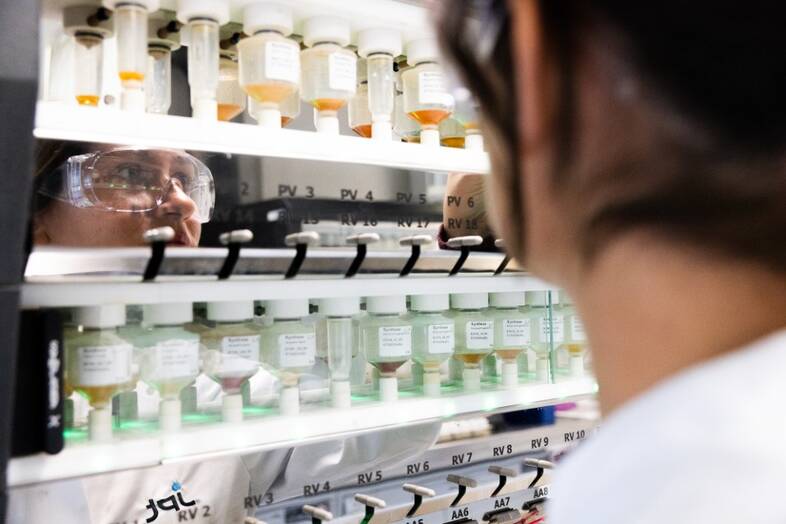
All of JPT has moved into the new building, which we proudly named „The HoP” – the House of Peptides. Our core activity is the chemical synthesis of peptides and peptide-related services, and all departments have now moved into this facility. This includes administration, sales, production, and management, which were previously spread across several buildings. Bringing everyone together under one roof is one of the most immediate and recognizable benefits. The new layout is much better aligned with our manufacturing workflows, eliminating fragmentation across floors and buildings.
This saves time, improves communication, and ensures smoother handovers between departments. We have also invested significantly in automation to increase process efficiency and workplace safety. At the same time, employee well-being was a key consideration. The building offers social areas, think tanks, comfortable offices, climate-controlled environments, and a rooftop cafeteria with a unique view over the Landschaftspark Johannisthal and Berlin’s eastern skyline – where grazing sheep and the Fernsehturm are part of the same panorama. This combination creates a very special working atmosphere.
4. You can look back on a long and successful company history. Founded in 2004, you have been a wholly owned subsidiary of BioNTech SE since 2009. What were the most important factors (at the location) that helped you become so successful?
Since its founding in 2004, JPT had developed as an independent commercial company serving the global life science community. It became a wholly owned subsidiary of BioNTech SE in 2009. Our success is rooted in deep technological expertise and a strong focus on innovation.
JPT was founded around its proprietary high-throughput peptide synthesis technology, which enables the production of thousands of peptides per day. This capability opened entirely new possibilities, particularly during the era of human genome sequencing. In this context, JPT was also a partner in the Human Proteome Project.
Over the years, we have continuously expanded our portfolio through technological innovations in areas such as quantitative proteomics, immunomonitoring, and vaccine development. We are proud to have been among the first companies to offer peptide libraries for SARS-CoV-2, thereby supporting COVID-19 research worldwide.
Most recently, we launched TravirtideTM, a newly patented peptide designed for cell and gene therapy applications. I believe that our success is driven by a combination of technological foresight, continuous innovation, robust manufacturing expertise, and an uncompromising commitment to quality.
5. How do you see the future of peptide technologies in medicine and biotechnology?
Peptide technologies are entering a very exciting phase. For a long time, peptides were primarily seen as research tools, but today they are increasingly recognized as powerful therapeutic and enabling modalities. Advances in synthesis, formulation, delivery technologies, and analytics have significantly expanded what is possible.
High specificity, favorable safety profiles, and modular design make peptides particularly attractive in combination therapies and precision medicine approaches.
From a biotechnology perspective, the ability to produce peptides at scale, with high quality and speed, is becoming a key differentiator. High-throughput platforms, automation, and data-driven design are transforming peptide discovery and development, while sustainable manufacturing and GMP-ready processes will further accelerate clinical translation.
I am convinced that peptides will act as a connecting technology – bridging chemistry, biology, and digital innovation – and will be an essential component of next-generation medicines. With the right infrastructure, talent, and ecosystem, locations like Berlin are exceptionally well positioned to play a leading role in shaping this future.
Further information:

