
In Portrait | Print rather than build – AMBER helps Berlin to become 3D printing capital
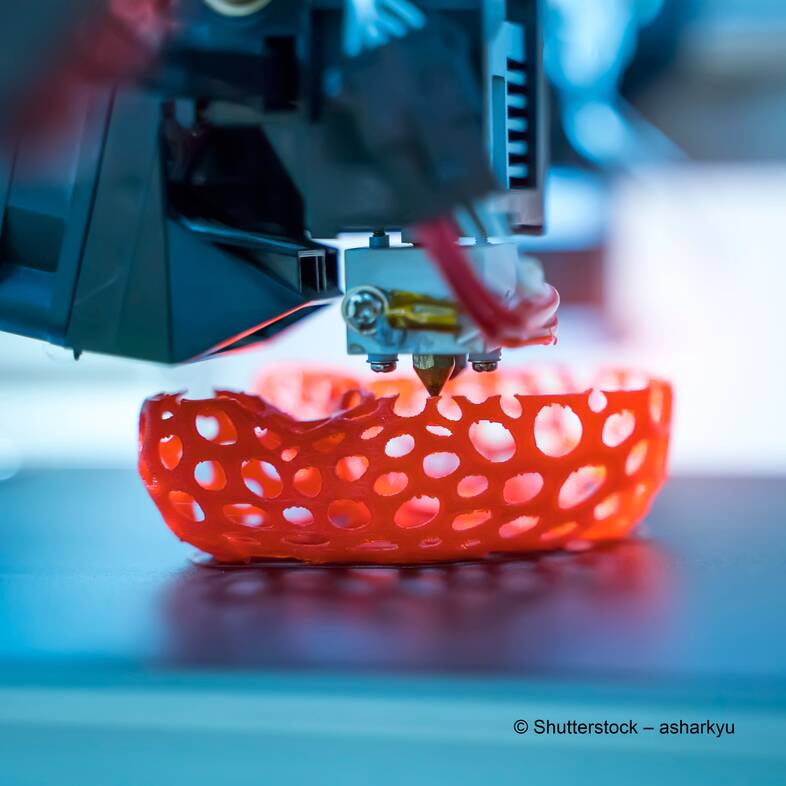
Additive Manufacturing (AM) – professional 3D printing – is becoming increasingly relevant in various industrial sectors: transportation, aerospace technology, precision manufacturing of components, prototyping in manufacturing, and, last but not least, medical and biotechnology (bioprinting). In medical technology in particular, the decisive advantage lies in the ability to personalize the required parts for each patient. Other fundamental advantages of AM over conventional manufacturing methods include cost and time savings in production and greater sustainability thanks to low material consumption and good recycling options.
An initiative with an ambitious goal
The potential of AM was recognized early on in Berlin, and the capital region has set itself the goal of becoming Europe's leading industrial location for 3D printing by 2030. “The 3D printing initiative AMBER was brought into being to advance this development,” says AMBER Coordinator Leon Tillmann. AMBER is short for Additive Manufacturing Berlin-Brandenburg and is coordinated by Berlin Partner for Business and Technology. The AMBER initiative is initially scheduled to run from 2022 through 2027, and currently connects over 60 stakeholders from science, business and industry, pooling expertise in research and development and making Berlin a hub for innovations in Additive Manufacturing. Players participating in AMBER include Fraunhofer IPK, the Bundesanstalt für Materialforschung (BAM; German Federal Institute for Materials Research) with its competence center for Additive Manufacturing, the Werner von Siemens Centre for Industry and Science, TU Berlin, B-TU Cottbus and Charité – Universitätsmedizin Berlin.
Funding by AMBER
One of AMBER’s main tasks is funding top research projects. To this end, the AMBER call with a total volume of EUR 14 million was launched in 2022. Thirteen projects are currently being funded in the three sub-areas of Medical Technology, Lightweight Construction and Areospace. Almost half of the AMBER projects are researching into groundbreaking manufacturing technologies and approaches for promising innovative materials for pioneering biomedical applications.
The six funded projects in Medical Technology include AVATAR, which develops patient-specific tumor models for cancer research. Project partners are Cellbricks GmbH, Charité – Universitätsmedizin Berlin and TU Berlin. The perKunSt project is working on personalized stents made from biodegradable plastics, and as part of ProAStra Dental, scientists are researching the Additive Manufacturing of novel root-analog dental implants using a highly automated, software-supported manufacturing chain. “This development in such a short time has only been possible thanks to the excellent interdisciplinary cooperation with our partners Trinckle GmbH and TU Berlin, as well as the support provided by AMBER,” stresses the scientific coordinator responsible for ProAstra Dental, Andreas Schwitalla, a specialist dentist for oral surgery and professor of digital implantology at Charité.
Networking and creating visibility
In addition to project funding, AMBER is also responsible for numerous other activities. “For example, we organize the AMBER network meeting at least twice a year, bringing together participants from companies, start-ups and academia,” says AMBER Coordinator Leon Tillmann. “The AMBER Spotlight series is a new event format that examines Additive Manufacturing in various technological and application-related areas.” AMBER is also regularly represented at trade fairs focusing on AM, both nationally and internationally. For example, AMBER is organizing a joint stand for regional exhibitors from the capital region at Formnext this coming November. Delegation trips visit regions around the world that are also focusing on AM. For example, in February of this year, the AMBER Tech Journey 2025 visited New York and Boston. In addition, AMBER is playing an active part in Berlin’s AM Forum, the biggest user conference for Additive Manufacturing in Europe. Around 700 decision-makers and experts gathered in Berlin in March for the ninth edition of the AM Forum. At the opening of the conference at the Adlon Hotel, one of the speakers was Berlin State Secretary Dr. Severin Fischer, who emphasized the political commitment to and importance of Additive Manufacturing for Berlin.
“In addition to projects and activities, our tasks include building and maintaining the community. This also means that we are happy to inform companies about the wide range of applications for 3D printing,” Tillmann explains. Furthermore, AMBER administers a virtual presentation of the regional AM community and provides an overview of the ecosystem along the entire AM value chain as well as the experts who are active in the field of Additive Manufacturing in the capital region.
Further information

