
Portrait | The Green Health Accelerator brings climate tech to the healthcare sector
Daily life in the healthcare sector is soften marked by cost pressure as well as a lack of qualified staff and planning security. According to the Krankenhaus-Barometer 2025, a survey among German hospitals by Deutsches Krankenhausinstitut, 66 percent of respondents incurred losses in 2024, and 71 percent expect a negative annual result for 2025. Increasing prices and tight budgets make it difficult for hospitals to invest into new technologies for sustainable processes.
At the same time, ecological pressure is weighing on the healthcare sector. According to health care’s climate footprint report, the health care sector accounts for about 4.4 percent of global greenhouse gas emissions. For Germany, the Bundesärtztekammer (German Medical Association) reports a 5.2 percent share in national emissions for the healthcare sector, with hospitals playing a special role. They operate 24/7 and have to meet high standards regarding hygiene and air conditioning. Consequently, they use energy-intensive building and medical technology.
Bringing established sustainable solutions to the healthcare market
The Green Health Accelerator program addresses this tension between economic and environmental pressures to act. It connects climate-tech companies and the healthcare sector with the aim of further developing products and business models for use in hospitals and care facilities, so they can be tested in concrete pilot projects.
This is intended to help both the environment and healthcare facilities. After all, energy efficiency, waste reduction or optimized logistics are not just climate protection issues. They can also help reduce running costs and mitigate the problem of scarce personnel resources. The accelerator is part of the program Nachhaltig wirken – Förderung gemeinwohlorientierter Unternehmen (Sustainable Impact – Support for Public-Interest Enterprises), which is funded by the German Federal Ministry for Economic Affairs and Energy, the European Union and the European Social Fund Plus.
The equity-free program is not targeted at young companies that are just launching their business models, but at established impact start-ups and scale-ups that offer market-ready solutions. “The companies we work with don't have to start from scratch in the healthcare sector, because their solutions are already working in other industries. Our job is to help them adapt their solutions to one of Germany's most complex and at the same time most important markets,” says Stefanie van Laak, Project Lead of the Green Health Accelerator.
The accelerator has a broad scope in terms of the focus areas that companies can bring to the program. It lists the following: energy efficiency, smart building management, process efficiency in hospital operations, waste management, circular economy, sustainable materials and sustainable mobility.
Leading up to a pilot project in six months
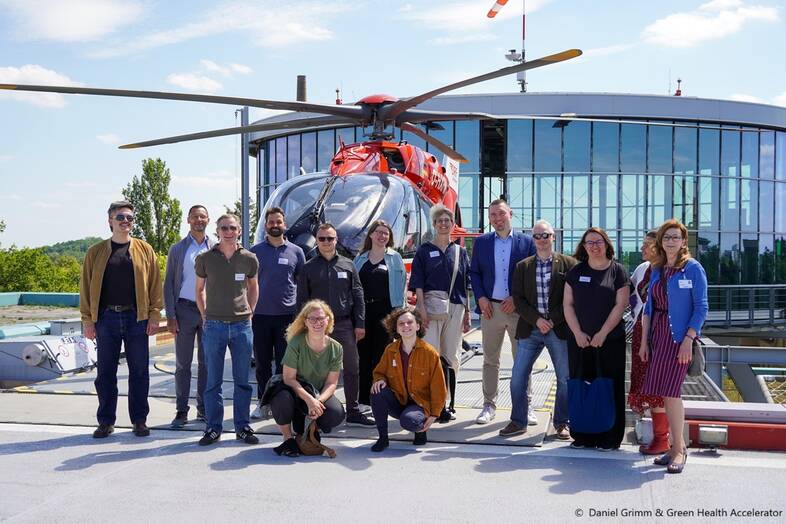
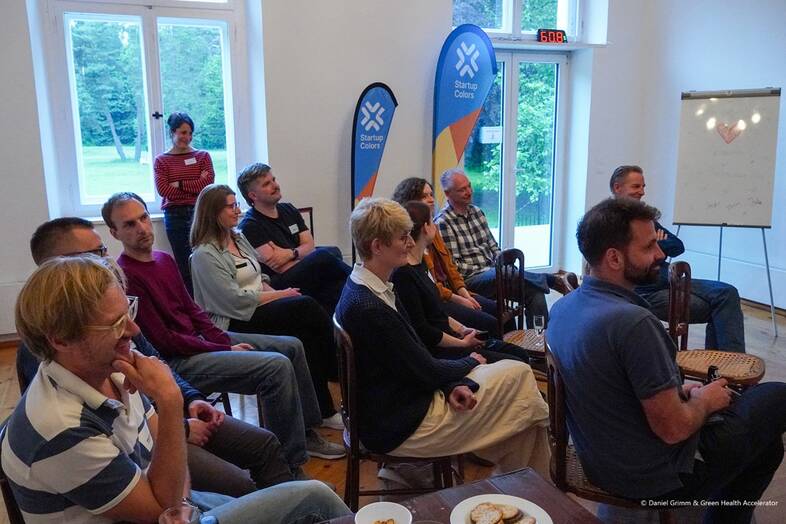
The program with a duration of six months is divided into two phases. The first three months are dedicated to laying the foundation for entering the healthcare market. Participating companies learn how hospitals operate, what they need, how they make decisions, allocate budgets and procure solutions. The program kicks off with a two-day boot camp that can be held in the Berlin-Brandenburg metropolitan or the Lusatia region – or other federal states, such as Mecklenburg-Western Pomerania. Following this, the program will offer, among other things, remote collaboration and individual coaching. The insights gained from workshops, expert panels, hospital visits and regular one-on-one meetings are expected to result in a draft pilot project by the end of the first phase.
In its second phase, the program gradually moves into practical implementation. The accelerator connects companies with hospitals, long-term care facilities and other partners that are suitable for a real-world test. This matchmaking is intended to result in a concrete, coordinated pilot project that will ideally lead to a long-term collaboration. A final showcase event offers the companies the opportunity to present their solutions to an audience of experts and potential further partners.
At the moment, 17 companies from across Germany participate in the Green Health Accelerator’s program. Participants from Berlin include Factor4Solutions GmbH, a company that offers AI-based control of cooling and heating systems, and Perto, which provides intelligent building and energy management with real-time monitoring and automation of heating systems. Another participant from Berlin is Omto GmbH, a company offering digital infrastructure for the qualified transport of patients. This directly connects hospitals and transport companies without an intermediary, thus saving time and avoiding unnecessary patient transports.
The current companies are the fourth cohort to participate in the Green Health Accelerator. The program focuses on collaborations between climate-tech companies from across Germany and healthcare facilities in the new federal states. The accelerator itself is headquartered in Senftenberg in Brandenburg and has branch offices in Berlin. It is run by Startup Colors UG, an agency for innovation consulting founded in 2018 that also runs the Vision Health Pioneers Incubator, and supported by Berlin Partner for Business and Technology as well as HealthCapital, the Healthcare Industries Cluster Berlin-Brandenburg. In addition, there are close partnerships with regional hospitals, among them Vivantes, Sana Klinikum Niederlausitz, UKB Berlin Marzahn, Klinikum Waren and Universitätsmedizin Rostock as well as Greifswald.
Further Information:
- Green Health Accelerator
- Bundesärztekammer (German Medical Association) on the healthcare sector’s carbon footprint
- Health care’s climate footprint report
- Krankenhaus-Barometer 2025 des Deutschen Krankenhausinstituts
- Factor4Solutions GmbH
- Perto
- Omto GmbH

