


Special Topic | Si-M and BeCAT – Berlin-based research centers for innovative therapy development
A better understanding of interdependencies
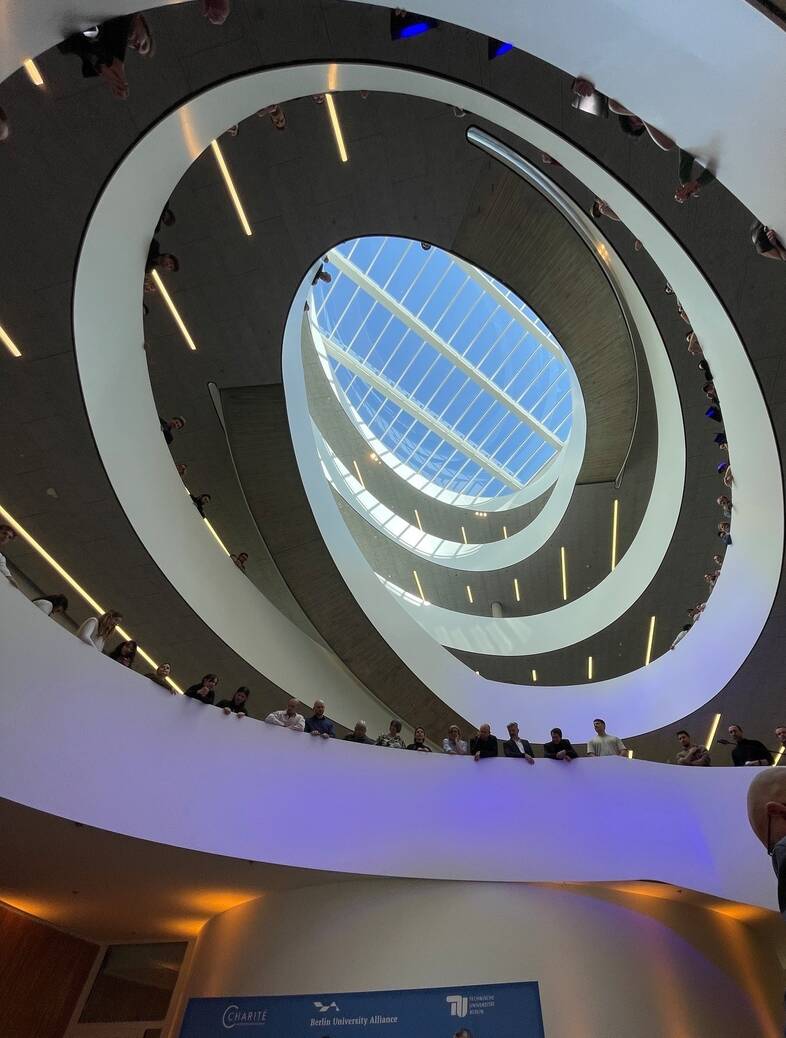
The shift toward precision medicine requires a deep understanding of diseases, their dynamics within the body and human physiology in general. This is precisely where two new research centers in Berlin come in – Der Simulierte Mensch (Si-M) and the Berlin Center for Advanced Therapies (BeCAT). In the last couple of years, new buildings with research infrastructure were constructed for both these institutions. These were inaugurated on April 22, 2026, on the Charité Campus Virchow-Klinikum for Biotechnology and Medical Technology, in the presence of many guests from the fields of science, healthcare and politics.
Simulating human (patho)physiology
The Si-M has three laboratory levels: subcellular, cellular and organs/tissues. Their goal is to study human physiology and disease processes as realistically as possible in human-based models. Si-M’s model systems primarily aim to simulate human (patho)physiology, replicating diseases and their dynamics. The practical significance of these models for the development of new therapy approaches is that they enable new insights based on the discovery of fundamental mechanistic patterns. Using 3D culture, bioprinting and multi-organ chips, the Si-M produces human tissue and organ models from patient-derived material, replicating specific disease states such as tumors, inflammation or metabolic disorders. With the help of complex analytical methods, bio-printed tumor and isolated lung models can show, for example, how cancer cells interact with other cell types, how the tumor microenvironment differs from healthy tissue, how infections invade tissues and how pathological processes develop over time. “We hope to be able to trace the mechanisms underlying the development of diseases at the level of human cells and tissues – and derive new therapeutic approaches from these insights,” says Si-M Scientific Coordinator Shirin Kadler.
Cutting-edge cell and gene therapies
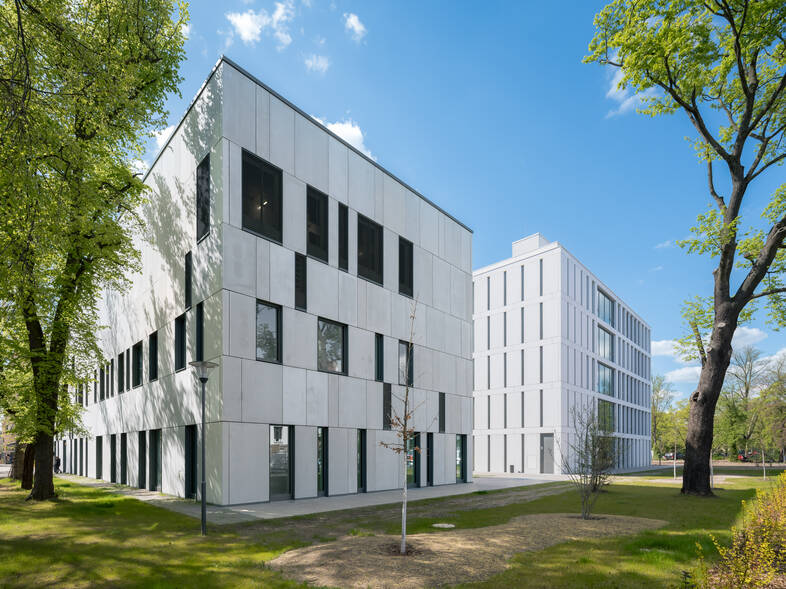
BeCAT focuses on the development, production and application of ATMPs, which are expected to fundamentally transform medical treatments. Rather than just cure the noticeable symptoms of illnesses, these treatments aim to heal the underlying causes and sustainably restore health. To realize this target, Charité brings together its relevant expertise in basic and clinical research, process development and quality control at BeCAT. The institution has already been active in research, development and publication since 2018, situated in the Cranach Haus on Charité Campus Virchow-Klinikum.
BeCAT is now intended to facilitate the transition from preclinical research using novel and clinically relevant in vitro and in vivo models to clinical research on ATMPs. To realize this, the new research building features a modular GMP (Good Manufacturing Practice) laboratory unit. GMP describes the quality assurance guidelines under which pharmaceuticals must be manufactured to ensure quality, safety and reproducibility. The establishment of a manufacturing process that meets these requirements is a prerequisite for the successful use in patients as part of a clinical trial. It is also a key step in the transition from the development of therapeutic approaches using ATMPs to their clinical application. “So far, there has been no manufacturing site of this size and complexity for pharmaceuticals at Charité. Consequently, we have a lot of new processes to establish”, states BeCAT Director Prof. Annette Künkele-Langer.
From planning to implementation
The result of extensive planning and design, both institutions are state-of-the-art in terms of their respective objectives. The planning process for Si-M started back in 2017, when TU Berlin and Charité agreed to collaborate with the goal of developing a joint medical and biotechnology campus. Among other things, TU Berlin contributed its expertise in microfluidics and bioprinting, while Charité brought its strengths in biomedical research and access to clinical questions, patient samples and data to the collaboration. In 2018, the construction of Si-M was jointly applied for by Prof. Roland Lauster, then Head of the Department of Medical Biotechnology at TU Berlin, and Prof. Andreas Thiel, Head of the Working Group Regenerative Immunology and Aging at Berlin Institute of Health at Charité (BIH). Construction work on both buildings started at the end of 2021.
With the opening, the ideas behind the two institutions are now being put into practice. At the Si-M in particular, scientists from Charité and TU Berlin are conducting interdisciplinary research and collaborate on modeling human cell and organ functions at the intersection of medicine and engineering. “It is our goal to forge new connections between disciplines and foster research ideas that often would not emerge within the traditional boundaries of individual fields,” explains Jennifer Rosowski, Scientific Coordinator and Team Lead at Si-M.
This work is also characterized by the targeted support of young researchers. A renewal cycle of about five to six years regularly creates opportunities for new topics and new talent. Si-M offers young group leaders, particularly those from established research fields, the opportunity to develop their own ideas in a modern research environment and to implement them in collaboration with experienced scientists.
Connections in research and development
The spatial proximity of BeCAT and Si-M fosters a close connection between human-based model research, preclinical validation and the GMP-compliant development of innovative therapeutics. “Si‑M and BeCAT are complementary institutions. This means that there will be future research projects to which Si‑M as well as BeCAT will contribute,” says Shirin Kadler. Findings on therapeutics tested at Si-M can be used directly in the further development of therapy approaches at BeCAT. “The possibilities of novel therapies seem limitless, and bringing these promising approaches into the clinic is BeCAT’s mission,” says Annette Künkele-Langer. “Researchers from institutions such as Charité, the Berlin Institute of Health at Charité (BIH), the Max Delbrück Center (MDC) or Si-M work with us to develop and manufacture drugs for early-stage clinical trials. We also help integrate these drugs under Berlin’s leadership into national networks such as the National Center for Tumor Diseases (NCT).”
Both institutions are also closely linked to other initiatives, including the future Berlin Center for Gene and Cell Therapies (BC-GCT), which is one of the key projects of Germany's High-Tech Agenda. “We are already in close contact with our colleagues at the Berlin Institute of Health, Bayer and ProBioGen, the company that will operate the BC-GCT’s GMP facility. We are sharing the experience and expertise needed for planning and commissioning new GMP facilities. And as there will probably be investigational drugs that, following a successful Phase I or II clinical trial, will become part of a spin-off and could therefore be transferred to the BC-GCT, it is important that we maintain close communication,” says Annette Künkele-Langer.
In the near future, both research centers will focus on the systematic establishment and expansion of their practical work. Jennifer Rosowski of Si-M says, “With its opening, Si-M has entered a new phase: The current goal is to fill the building with a vibrant scientific community and to foster new forms of collaboration through physical proximity.” In the coming years, one particular area of focus will be the support of new interdisciplinary research projects. “Another key milestone is the development of joint research activities and the acquisition of additional third-party funding to create the scientific freedom required for new interdisciplinary approaches.” BeCAT will also initially focus on laying the groundwork for the first results. “The commissioning of the new BeCAT building is the first major project. The initial investigational drugs to be manufactured at BeCAT are so-called CAR-T cells, white blood cells that have been genetically modified to recognize and destroy tumor cells. Our first milestone is obtaining a CAR-T cell manufacturing license for the new BeCAT building and to subsequently produce the first investigational drug for a patient,” Annette Künkele-Langer states.
Further information:
- Website BeCAT
- Website Si-M
- German Federal Ministry of Research, Technology and Space on the opening of the research centers
- HealthCapital on the opening of the research centers
- Current texts on future projects by HealthCapital: Zukunftsprojekte Berlin Brandenburg | Cluster Gesundheitswirtschaft Berlin-Brandenburg

