


Special Topic | At the Brain-Computer-Interface – NeuroTech for Therapy and Diagnostics in Berlin
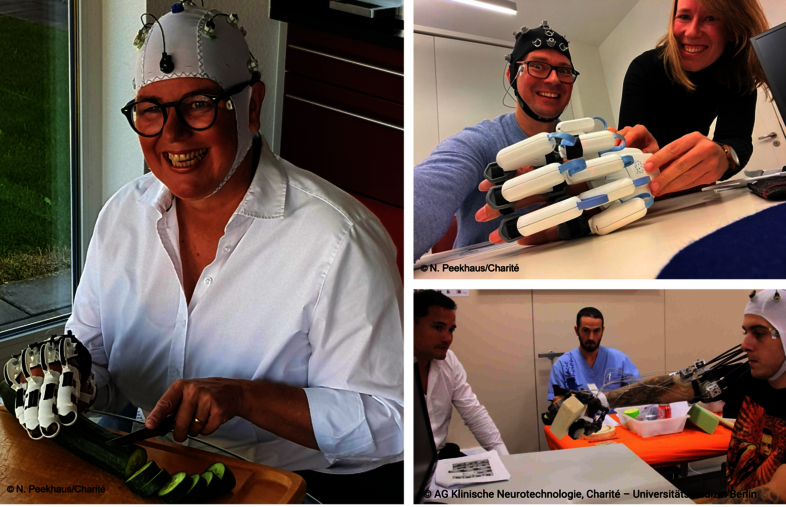
Neurotechnology is a fascinating development in modern medicine. It creates a direct connection between the human brain and digital systems, thus opening up possibilities that were unthinkable just a few years ago. NeuroTech is used wherever neural signals are monitored, decoded or specifically modified in research, diagnostics or therapy. Well-known applications in the field of diagnostics include computer tomography, electroencephalography (EEG) and functional magnetic resonance imaging (fMRI). Neurotechnology applications can therefore be defined as technological and computer-supported tools that analyze brain signals or are capable of specifically modifying them. Biomedical applications directly interacting with the brain are also regarded as neurotechnology. Specific medical applications in neurotechnology thus range from psychotropic drugs to neuroprosthetics.
Furthermore, quantum sensors are becoming increasingly important in neurological diagnostics, because they allow for the monitoring of brain activity with unprecedented precision. These developments expand the range of potential applications in neuroscience.
Neurotechnology at Charité
Extensive research, development and manufacturing related to all aspects of neurotechnology take place in the capital region. For example, Prof. Surjo Soekadar, head of the research group Clinical Neurotechnology at Charité – Universitätsmedizin Berlin, is regarded as a leading international authority in research and translation. He is a pioneer in the field of clinical neurotechnology and a sought-after speaker at events on the topic and beyond. In his work, Prof. Soekadar focuses on brain-computer interfaces, e. g., the control of external devices such as prosthetics by brain signals and the treatment of psychological conditions through the targeted stimulation of neural networks. Prof Soekadar describes the significance of neurotechnology and his work as follows, “For the first time ever, neurotechnology is opening up the possibility to directly interact with the human nervous system. It gives us the opportunity to restore lost functions and freedom of action and, at the same time, create new forms of interaction between human beings and technology.”
Last year, the Einstein Foundation Berlin decided to support Prof. Soekadar’s research with an Einstein Professorship for the second time. The focus of this second professorship will be on the intersection of neurotechnology and psychotechnology, meaning the combination of neurobiological, digital and psychosocial interventions. Another goal is the creation of a so called NeuroTech Open Innovation Hub to accelerate the clinical translation of neurotechnological developments. This hub is expected to coordinate closely with the newly founded ARC Innovation Center at Charité.
Prof. Dr. Petra Ritter is also conducting world-class research. She holds a Johanna Quandt Professorship in brain simulation at the Berlin Institute of Health (BIH). Her work focuses on the benefits of brain simulation for the diagnosis and treatment of disorders such as Alzheimer's disease, stroke and epilepsy. Prof. Ritter’s research group provides expert knowledge, tools and resources to transform raw brain imaging data into virtual patient avatars. Among other things, the objectives of Prof. Ritter’s research are to develop feasible, scalable software solutions and to interpret the results of the simulations in the best possible way to further develop brain simulation for various use cases such as personalized medicine.
New quantum sensors for research and treatment
The work of the OPM-MEG-Zentrum, opened by Charité – Universitätsmedizin Berlin and the German National Metrology Institute (PTB) at Campus Charité in October of 2025, focuses on a better understanding of neurological disorders such as schizophrenia, Parkinson’s disease and epilepsy. The center for magnetoencephalography (MEG) with optically pumped magnetometers (OPMs) aims to improve the diagnosis and treatment of psychiatric and neurological disorders. Under the center’s division of labor, the PTB will oversee the biomagnetic measurements using quantum sensors, while Charité will apply the measurement technology to research on neurological mechanisms and psychiatric disorders.
OPMs are a new type of quantum sensors that offer new opportunities by enabling the detection of brain signals at room temperature with an unprecedented combination of real-time and high-resolution spatial functional measurement. The core of the center is a full-head OPM system with 96 sensors, housed in a magnetically shielded booth. In addition, the center is advancing general research in quantum sensor technology and brain-computer interfaces, and is expanding its collaborations with the research community, business and start-ups.
NeuroCure – the cluster of excellence in neuroscience at Charité
NeuroCure, the cluster of excellence in neuroscience, has been established at Charité since 2007. The cluster is an interdisciplinary research association dedicated to the study of neurological and psychiatric disorders. The Humboldt Universität and the Freie Universität Berlin participate in the cluster, as well as the non-university research institutions Max Delbrück Center for Molecular Medicine (MDC), Leibniz-Forschungsinstitut für Molekulare Pharmakologie (Leibniz Research Institute for Molecular Pharmacology, FMP), Max Planck Unit for the Science of Pathogens (MPUSP) and Deutsches Zentrum für Neurodegenerative Erkrankungen (German Center for Neurodegenerative Diseases, DZNE). Part of NeuroCure is the NCRC, the Neuroscience Clinical Research Center for conducting clinical trials. The center's goal is to translate new findings from basic neuroscience research into clinical applications as quickly as possible. Towards this end, the NCRC conducts trials on diseases such as stroke, multiple sclerosis, dementia, epilepsy and psychiatric disorders. Patients participating in these trials get access to new diagnostic and therapeutic approaches.
Fraunhofer IZM participates in NerveRepack
The research project NerveRepack is another European alliance of research institutions, universities and industry leaders in NeuroTech. This multi-faceted consortium works to improve the quality of life for people with amputated or paralyzed limbs through neurotechnology. Towards this end, the project designs innovative implantable neural interfaces that can communicate with the patient via exoprostheses and exoskeletons, with communication also working in the opposite direction. The Berlin-based Fraunhofer Institute for Reliability and Microintegration IZM participates in NerveRepack. The institute collaborates in the design of the implantable module and develops a biocompatible thin-film encapsulation that enables long-term operation of the device inside the human body.
Berlin-based companies in NeuroTech
Outside the realm of research, many other stakeholders from the capital region – among them start-ups as well as companies that have been established for some time – are active in field of neurotechnology.
One example is eemagine Medical Imaging Solutions GmbH, which has been manufacturing hard- and software for transcranial magnetic stimulation (TMS) neuronavigation as well as the collection and analysis of electroencephalography (EEG) data in Berlin since 1999. The products are distributed throughout the world by ANT Neuro. Through this collaboration, both companies are focusing in particular on neuronavigation for the treatment of depression using TMS and EEG in neurosciences and clinical applications. To improve treatment for drug-resistant depression, methods of non-invasive brain stimulation are developed further in research collaborations with clinical partners such as Charité.
Today, eemagine is one of the leading global manufacturers of innovative neurotechnology. Dr. Frank Zanow, founder and CEO of eemagine, comments on Berlin as a location for NeuroTech, “The decision to establish the company in Berlin has proven to be exactly the right choice, thanks to the proximity to our academic and clinical partners, the city’s appeal – particularly to foreign employees – and our connections with other stakeholders in the region.”
Another company that improves patients’ quality of life through neurotechnology is Biotronik. Since founded in Berlin in 1963, Biotronik has mainly been manufacturing pacemakers and monitoring systems. One of the more recent additions to the company’s portfolio is a spinal cord stimulation system (Prospera®Spinal Cord Stimulation – SCS) for the treatment of chronic back and leg pain. The implantable system promises to suppress and mitigate pain signals in the spinal cord.
Meanwhile, Ottobock – a manufacturer of medical devices with a branch office in Berlin – shows that orthoses have an important role to play in neurotherapy and rehabilitation. With a set of about 50 electrodes, the company’s exopulse suit can contribute to the reduction of typical spastic symptoms and mitigate chronic pain in disorders such as cerebral palsy, multiple sclerosis and stroke.
American company NIRx specializes in supporting brain research by imaging technologies. NIRx was founded in 1988 and now has headquarters in Berlin and Orlando. The company’s light-based fNIRS tomography provides reliable images of the brain and its activities for research purposes.
The technology of Berlin-based start-up Nocturne is also taking a look inside the brain. Software developed by the founders uses the eye as a window to the brain and analyzes images of the retina with the help of artificial intelligence. These images support the diagnosis and the assessment of the progression of neurological disorders.
Nuuron, another Berlin-based NeuroTech start-up, intervenes in the course of Alzheimer’s disease. The company is developing a memory stimulator for patients with dementia. Nuuron’s neuromodulation technology directly stimulates the memory center in patients. This happens through ultra-high-frequency digital-photonic stimuli. These activate the memory center via the retina as a brain-computer interface (BCI) and ensure that memories are transferred from short-term back into long-term memory. Nuuron uses VR and AR glasses to do this. According to Fabian Queisner, founder and CEO of Nuuron, the start-up is currently conducting clinical trials involving patients with Alzheimer’s disease at Charité as well as animal testing at the German Center for Neurodegenerative Diseases (DZNE). In Queisner’s eyes, arguments in favor of Berlin as a start-up location were “the excellent environment for NeuroTech research provided by Charité and the attractiveness of the city of Berlin for our international team of scientists.”
Start-up InnoSphere, founded in 2017 as a spin-off of Berlin’s Humbolt-Universität, also focuses on stimulating the brain. Headquartered in Berlin and Haifa, the company is developing Novostim, a wearable medical cap that enables non-invasive electrical brain stimulation for the treatment of ADHD in children and specifically trains certain areas of the brain during play-based activities. It aims to sustainably reduce ADHD symptoms. InnoSphere has recently completed an FDA study relevant to regulatory approval in collaboration with leading clinics, has received Israeli AMAR approval and is now preparing the CE certification process for the coming year in collaboration with Charité.
Events in Berlin foster NeuroTech innovation
Events focusing on neurotechnology in Berlin highlight the fact that technological solutions for the neurosciences are attracting a great deal of attention – and not just within the scientific community. The annual ANT Neuromeeting has been taking place for over 25 years and the Berlin Neuroscience Meeting (BNM) has been held in the capital for nearly a decade. And this year’s Berlin Quantum Hackathon, supported by Berlin Quantum and the Senate Department for Economic Affairs, Energy and Public Enterprises, dedicated one of two challenges to the topic of Brain-Computer-Interfaces & Neuromodulation. The use of quantum technologies in the field of NeuroTech will also be a topic of the DMEA session “Quantenmedizin im Aufbruch: Sind wir bereit für den nächsten Sprung?” (Quantum medicine on the move: Are we ready for the next leap?) hosted by Cluster HealthCapital on April 21.
Further Information:
- Einstein Professorship for Prof. Surjo Soekadar
- Prof. Dr. Petra Ritter, BIH Johanna Quandt Professor for Brain Simulation
- New ARC Center at Charité
- Opening of OPM-MEG Center (German only)
- NeuroCure cluster of excellence in neurosciences
- NerveRepack at the Fraunhofer Institute for Reliability and Microintegration IZM
- Website ANT neuro
- Website eemagine Medical Imaging Solutions GmbH
- HealthCapital-Portrait eemangine
- Biotronik Prospera®
- Otto Bock exopulse suit
- NIRx
- Nocturne
- Nuuron
- Innosphere

